
Crawlkit vs Screenshot to Code

Last updated: February 28, 2026

Screenshot to Code
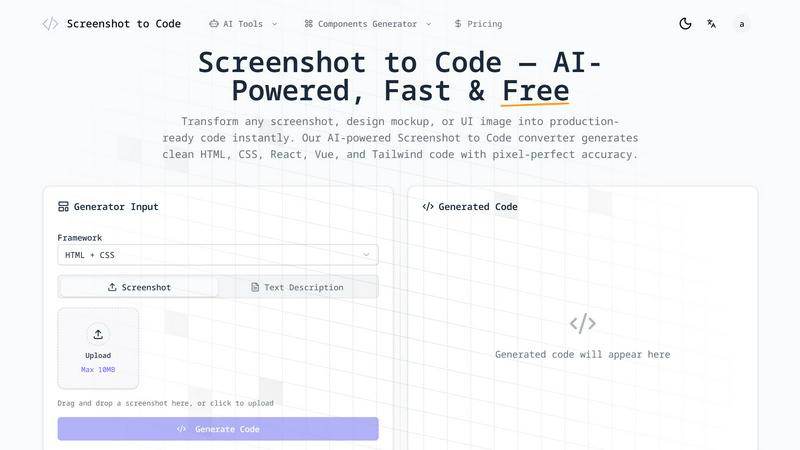
Stop coding from scratch; instantly convert any screenshot into clean, production-ready HTML and React code with AI.
Last updated: February 28, 2026
Visual Comparison
Crawlkit

Screenshot to Code
Feature Comparison
Crawlkit
One API for Every Data Source
CrawlKit enables users to extract structured data from a variety of websites, social platforms, and app stores using a single API call. This universality simplifies the data extraction process, allowing developers to gather data seamlessly from sources like LinkedIn, Instagram, app stores, and more.
Automated Data Collection
Forget about the cumbersome tasks of managing proxies, handling rate limits, or dealing with anti-bot measures. CrawlKit automates these processes, ensuring that users get clean, structured data without needing to worry about the underlying complexities of web scraping.
Real-Time Data Accuracy
CrawlKit guarantees complete and accurate data by waiting for full page loads and validating responses before returning results. This commitment to quality means users can trust that the data they receive is not only comprehensive but also reliable for their analysis and reporting needs.
Flexible Pricing Model
CrawlKit employs a transparent credit-based pricing structure, with no hidden fees or surprise charges. Users can easily scale their API usage based on their needs, allowing them to manage costs effectively while accessing extensive data resources.
Screenshot to Code
Multi-Framework Code Generation
Don't get locked into a single tech stack. Screenshot to Code empowers you to generate clean, ready-to-use code in the framework of your choice. Instantly convert your screenshot into vanilla HTML & CSS, React components (with JSX), Vue 3 single-file components, utility-first Tailwind CSS, Bootstrap, Ionic, or even SVG. This flexibility ensures seamless integration directly into your existing project, eliminating the need for tedious manual refactoring.
Gemini-Powered AI Visual Recognition
Forget about basic shape detection. Screenshot to Code is powered by cutting-edge AI models like Gemini Vision, which provides human-like comprehension of complex UI layouts. It doesn't just see boxes and text; it intelligently identifies interactive components like buttons, forms, and navigation menus, understands their hierarchical relationships, and interprets design context to generate semantically correct and logically structured code every single time.
Pixel-Perfect Accuracy & Responsive Output
This tool guarantees visual fidelity. Our engine meticulously analyzes your original design, preserving exact layouts, precise spacing, typography, colors, and responsive breakpoints. The generated code isn't just a rough approximation; it's a faithful, pixel-perfect translation that maintains the designer's intent, ensuring the final product looks and behaves exactly as envisioned, across device sizes.
Instant Live Preview & One-Click Export
See your code come to life in real-time. The integrated live preview editor allows you to review the generated output immediately, making quick adjustments if needed. When you're satisfied, export your work instantly with a single click—download organized, commented code files or copy directly to your clipboard. This streamlined workflow integrates directly into your development process with zero friction.
Use Cases
Crawlkit
CRM Enrichment
CrawlKit can enrich Customer Relationship Management (CRM) systems by automatically pulling LinkedIn profile data, including job titles, company information, and contact details for each lead. This ensures that sales teams have access to up-to-date and relevant information to drive their outreach efforts.
Social Media Analytics
Track the growth of competitors on social media platforms like Instagram with CrawlKit. By monitoring follower counts, engagement rates, and analyzing top-performing posts over time, businesses can refine their social strategies and stay ahead of the competition.
Competitive Intelligence
Utilize CrawlKit to gather intelligence on competitors by extracting data from their online presence. Analyze their product offerings, pricing strategies, and customer reviews to gain insights that can inform your business strategy and decision-making.
App Review Analysis
CrawlKit enables users to pull comprehensive reviews from app stores, allowing for in-depth analysis of user feedback. This data can be invaluable for product development, marketing strategies, and understanding customer sentiment towards apps.
Screenshot to Code
Rapid Prototyping & MVP Development
Speed is your ultimate weapon. Transform a napkin sketch or a quick Figma mockup into a functional, interactive prototype in under a minute. Screenshot to Code allows developers and entrepreneurs to validate ideas, demonstrate concepts to stakeholders, and build MVPs at a pace that leaves manual coding—and your competitors—in the dust.
Streamlining Developer-Designer Handoff
Eliminate the costly back-and-forth and misinterpretation that plagues traditional handoffs. Designers can simply export a screenshot of their final mockup, and developers can feed it into Screenshot to Code to receive instant, production-quality code. This creates a seamless bridge between teams, drastically reducing development cycles and ensuring design integrity is never compromised.
Converting Legacy UI & Client References
Modernizing an old website or building from a client's provided image reference is now trivial. Simply take a screenshot of the existing UI or the client's inspiration (like a competitor's site or a PDF wireframe) and let the AI generate the foundational code. This bypasses hours of tedious reconstruction, allowing you to focus on functionality and improvements instead of reverse-engineering visuals.
Learning & Code Generation for New Frameworks
Accelerate your learning curve for a new CSS framework like Tailwind or a component library like Ionic. By uploading a clean UI design and selecting your target framework, you can instantly see how experts would structure and style the code. It's an invaluable tool for understanding framework-specific patterns and best practices through practical, generated examples.
Overview
About Crawlkit
CrawlKit is a powerful web data extraction platform tailored for developers and data teams who require dependable and scalable access to web data without the hassle of building or maintaining scraping infrastructure. In an era where modern web scraping often involves complex challenges—such as managing rotating proxies, headless browsers, anti-bot protections, and rate limits—CrawlKit eliminates these headaches. By sending a simple request, users can rely on CrawlKit to handle the intricacies of proxy rotation, browser rendering, retries, and blocking. This allows teams to focus on what truly matters: leveraging the collected data for insights and decision-making. The platform supports a wide range of data extraction needs, offering access to various data types through a single, consistent interface. Whether it is obtaining raw page content, search results, visual snapshots, or professional data from platforms like LinkedIn, CrawlKit has you covered.
About Screenshot to Code
Screenshot to Code is a battle-tested, AI-powered engine that obliterates the barrier between design and development. It's not just another converter; it's a direct pipeline from visual concept to production-ready code. This tool is engineered for front-end developers, UI/UX designers, and product teams who are tired of the tedious, error-prone manual translation of screenshots, Figma mockups, or even hand-drawn sketches into functional HTML and component code. Its core value proposition is ruthless efficiency: reclaim 90% of the time you waste on repetitive markup and styling. While other tools promise conversion, Screenshot to Code delivers pixel-perfect, framework-specific code with military precision. It goes beyond simple element detection, utilizing advanced computer vision to understand layout hierarchies, spacing relationships, and design intent, generating clean, semantic, and maintainable code in seconds. This is the definitive tool for accelerating prototyping, streamlining developer-designer handoff, and bringing ideas to life at an unprecedented pace.
Frequently Asked Questions
Crawlkit FAQ
What types of data can I extract using Crawlkit?
CrawlKit allows you to extract various types of data, including raw page content, structured search results, visual snapshots, and professional data from platforms like LinkedIn and Instagram, all accessible via a single API.
How does Crawlkit handle anti-bot protections?
CrawlKit is designed to manage anti-bot protections by utilizing advanced techniques such as proxy rotation, browser rendering, and handling retries. This means users can extract data without being blocked or encountering disruptions.
Is there a limit to how much data I can extract?
CrawlKit operates on a credit-based system, allowing users to scale their data extraction based on their needs. There are no monthly commitments or rate limits, giving you flexibility in your data gathering efforts.
How do I get started with Crawlkit?
Getting started with CrawlKit is simple. You can sign up and receive 100 free credits to test the platform. Install the SDK, and you can begin making API calls to extract the data you need immediately.
Screenshot to Code FAQ
What image formats and file sizes does Screenshot to Code support?
Screenshot to Code supports all common image formats including PNG, JPG, and WebP. You can upload files directly from your device, with a maximum file size limit of 10MB per image. This covers high-fidelity screenshots from design tools like Figma or Sketch, as well as photos of hand-drawn wireframes.
How accurate is the code generated by the AI?
The accuracy is exceptionally high, thanks to advanced AI models like Gemini Vision. It excels at identifying standard UI components, layouts, and styles. For clean, well-defined screenshots (e.g., from a design tool), the output is often pixel-perfect and production-ready. For complex or ambiguous images, the generated code serves as a superb, fully-structured foundation that requires only minor tweaks.
Which frameworks and technologies can it generate code for?
Screenshot to Code offers broad framework support to fit your stack. It can generate code for Vanilla HTML and CSS, React (with JSX), Vue 3, Tailwind CSS, Bootstrap, Ionic, and SVG. This covers the vast majority of modern web and mobile development workflows, allowing for direct integration without switching tools.
Is the generated code clean and maintainable?
Absolutely. Unlike many code generators that produce bloated, messy markup, Screenshot to Code is engineered to output clean, semantic, and well-structured code. It uses appropriate HTML tags, follows CSS best practices, and creates logically named components. The code is commented and organized, making it easy for you or your team to read, understand, and extend.
Alternatives
Crawlkit Alternatives
CrawlKit is a powerful web data extraction platform tailored for developers and data teams seeking reliable access to web data. As a tool within the Dev Tools category, it simplifies the complexities of modern web scraping, including handling rotating proxies, anti-bot protections, and browser rendering, allowing users to focus on leveraging the extracted data rather than grappling with the infrastructure behind it. Users often seek alternatives to CrawlKit for various reasons, including pricing concerns, the need for specific features, or compatibility with unique platform requirements. When exploring alternatives, it's crucial to evaluate factors such as ease of integration, scalability, customer support, and the overall robustness of data extraction capabilities to ensure the selected solution aligns with project needs and goals.
Screenshot to Code Alternatives
Screenshot to Code is a leading AI-powered code generator in the Dev Tools category. It instantly converts visual screenshots into clean, production-ready code for frameworks like HTML, React, Tailwind, Vue, Ionic, and Bootstrap. This tool is a game-changer for developers and designers looking to accelerate their prototyping and development workflows. Users often explore alternatives for various reasons. Some may require specific integrations or support for niche frameworks not covered. Others might be evaluating different pricing models, from freemium tiers to enterprise plans. Platform compatibility, such as desktop applications versus browser-based tools, and the need for advanced features like team collaboration or version history also drive the search for other options. When choosing an alternative, focus on core capabilities. The accuracy of the AI in interpreting complex designs is paramount. Evaluate the quality and cleanliness of the generated code across your required tech stack. Consider the tool's ease of use, speed, and how well it fits into your existing development environment to ensure a seamless and productive experience.