
AutomagicWP vs Screenshot to Code

Last updated: February 27, 2026

Screenshot to Code
Stop coding from scratch; instantly convert any screenshot into clean, production-ready HTML and React code with AI.
Last updated: February 28, 2026
Visual Comparison
AutomagicWP
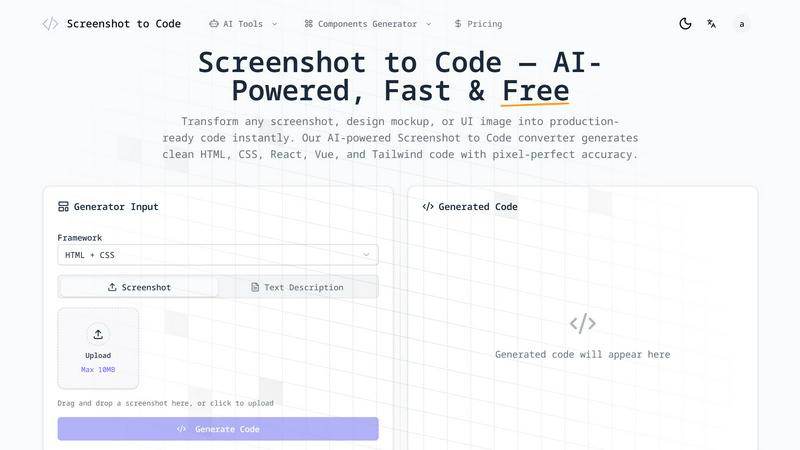
Screenshot to Code
Feature Comparison
AutomagicWP
One-Click, Site-Wide Updates
Upload a single plugin or theme release ZIP file to your AutomagicWP dashboard. Once published, the update propagates automatically to every connected WordPress site. The platform integrates directly with the native WordPress update checker, meaning your clients' sites will see and install the update just like they would from the official WordPress.org repository. This eliminates the need for manual FTP uploads or logging into individual wp-admin panels, saving hours of repetitive work and ensuring consistency across your entire network.
Professional Plugin Repository & Management
Turn your private plugins into first-class products. AutomagicWP provides a centralized dashboard to manage all your plugins, complete with support for icons, banners, screenshots, detailed descriptions, changelogs, and FAQs. This creates a professional, repository-like experience within the wp-admin of every connected site, building trust and clarity for end-users. You maintain full version history, can roll back to previous releases if needed, and have a single source of truth for all your distributed code.
Automated CI/CD Pipeline
Integrate your development workflow directly with deployment. By connecting your GitHub repository, you can trigger releases automatically by simply pushing a tag. The included GitHub Action handles the build and publishing process, creating a true "set it and forget it" pipeline. This means zero manual steps between merging code and shipping updates live to all sites, enabling rapid, reliable iteration and reducing the risk of human error in the release process.
Comprehensive API & Developer Toolkit
AutomagicWP is built for developers who demand control and flexibility. A full REST API allows you to integrate update distribution into your own custom tooling, dashboards, or client portals. For the client side, a dedicated Composer package seamlessly hooks into the WordPress update system on each site, ensuring clean, standards-compliant integration. This open architecture means you're never locked in and can tailor the update flow to your exact operational needs.
Screenshot to Code
Multi-Framework Code Generation
Don't get locked into a single tech stack. Screenshot to Code empowers you to generate clean, ready-to-use code in the framework of your choice. Instantly convert your screenshot into vanilla HTML & CSS, React components (with JSX), Vue 3 single-file components, utility-first Tailwind CSS, Bootstrap, Ionic, or even SVG. This flexibility ensures seamless integration directly into your existing project, eliminating the need for tedious manual refactoring.
Gemini-Powered AI Visual Recognition
Forget about basic shape detection. Screenshot to Code is powered by cutting-edge AI models like Gemini Vision, which provides human-like comprehension of complex UI layouts. It doesn't just see boxes and text; it intelligently identifies interactive components like buttons, forms, and navigation menus, understands their hierarchical relationships, and interprets design context to generate semantically correct and logically structured code every single time.
Pixel-Perfect Accuracy & Responsive Output
This tool guarantees visual fidelity. Our engine meticulously analyzes your original design, preserving exact layouts, precise spacing, typography, colors, and responsive breakpoints. The generated code isn't just a rough approximation; it's a faithful, pixel-perfect translation that maintains the designer's intent, ensuring the final product looks and behaves exactly as envisioned, across device sizes.
Instant Live Preview & One-Click Export
See your code come to life in real-time. The integrated live preview editor allows you to review the generated output immediately, making quick adjustments if needed. When you're satisfied, export your work instantly with a single click—download organized, commented code files or copy directly to your clipboard. This streamlined workflow integrates directly into your development process with zero friction.
Use Cases
AutomagicWP
WordPress Development Agencies
Agencies managing dozens of client sites can standardize and automate plugin updates across their entire portfolio. Instead of billing clients for manual update labor or risking inconsistent versions, they deploy a release once from AutomagicWP. Every client site updates itself reliably, ensuring all sites are secure, on the latest features, and uniformly maintained, which scales service delivery and improves profitability.
Independent Plugin & Theme Developers
Solo creators and small shops distributing premium or private WordPress products can use AutomagicWP as a lightweight, professional distribution channel. It provides all the infrastructure of a commercial platform—update delivery, changelogs, and a polished admin interface—without the complexity, fees, or feature bloat. Developers can focus on building their product while their customers enjoy a seamless update experience.
Enterprises with Internal WordPress Platforms
Companies that develop and maintain custom plugins for their own internal network of WordPress sites (e.g., for departments, brand sites, or franchises) need controlled, reliable distribution. AutomagicWP acts as a private, secure app store, ensuring that internal tools are rolled out consistently and quickly across the entire organization without relying on manual IT processes.
Freelancers Managing Multiple Client Sites
Freelancers who maintain several client websites often juggle similar plugins across them. Manually updating a contact form or SEO plugin on 10 different sites is inefficient. With AutomagicWP, the freelancer can manage their own "fork" or commonly used plugins, pushing updates from a single dashboard and freeing up time for higher-value development and client support work.
Screenshot to Code
Rapid Prototyping & MVP Development
Speed is your ultimate weapon. Transform a napkin sketch or a quick Figma mockup into a functional, interactive prototype in under a minute. Screenshot to Code allows developers and entrepreneurs to validate ideas, demonstrate concepts to stakeholders, and build MVPs at a pace that leaves manual coding—and your competitors—in the dust.
Streamlining Developer-Designer Handoff
Eliminate the costly back-and-forth and misinterpretation that plagues traditional handoffs. Designers can simply export a screenshot of their final mockup, and developers can feed it into Screenshot to Code to receive instant, production-quality code. This creates a seamless bridge between teams, drastically reducing development cycles and ensuring design integrity is never compromised.
Converting Legacy UI & Client References
Modernizing an old website or building from a client's provided image reference is now trivial. Simply take a screenshot of the existing UI or the client's inspiration (like a competitor's site or a PDF wireframe) and let the AI generate the foundational code. This bypasses hours of tedious reconstruction, allowing you to focus on functionality and improvements instead of reverse-engineering visuals.
Learning & Code Generation for New Frameworks
Accelerate your learning curve for a new CSS framework like Tailwind or a component library like Ionic. By uploading a clean UI design and selecting your target framework, you can instantly see how experts would structure and style the code. It's an invaluable tool for understanding framework-specific patterns and best practices through practical, generated examples.
Overview
About AutomagicWP
AutomagicWP is the definitive private distribution platform built to liberate WordPress developers and agencies from the manual, soul-crushing grind of plugin and theme updates. Forget the endless cycle of building ZIP files, logging into countless wp-admin dashboards, and manually uploading updates one by one. AutomagicWP replaces that archaic workflow with a single, powerful command center. You upload a release once, and every connected WordPress site updates itself automatically through WordPress's native update mechanism. It's not just a tool; it's a strategic advantage designed for those who build and manage WordPress products at scale. Whether you're a solo developer tired of the "ZIP loop," an agency managing a portfolio of client sites, or a creator distributing a premium plugin without the overhead of a full e-commerce platform, AutomagicWP delivers professional-grade distribution, complete with changelogs, version history, and seamless CI/CD integration. This is distribution, automated and battle-tested for the real world.
About Screenshot to Code
Screenshot to Code is a battle-tested, AI-powered engine that obliterates the barrier between design and development. It's not just another converter; it's a direct pipeline from visual concept to production-ready code. This tool is engineered for front-end developers, UI/UX designers, and product teams who are tired of the tedious, error-prone manual translation of screenshots, Figma mockups, or even hand-drawn sketches into functional HTML and component code. Its core value proposition is ruthless efficiency: reclaim 90% of the time you waste on repetitive markup and styling. While other tools promise conversion, Screenshot to Code delivers pixel-perfect, framework-specific code with military precision. It goes beyond simple element detection, utilizing advanced computer vision to understand layout hierarchies, spacing relationships, and design intent, generating clean, semantic, and maintainable code in seconds. This is the definitive tool for accelerating prototyping, streamlining developer-designer handoff, and bringing ideas to life at an unprecedented pace.
Frequently Asked Questions
AutomagicWP FAQ
How does AutomagicWP's automatic updating work?
You connect each client's WordPress site to your AutomagicWP account using a unique API key and a small Composer package. This connection allows the site to check your private AutomagicWP repository for updates. When you publish a new release, WordPress's built-in update mechanism detects it on its normal schedule and installs it automatically, just like an update from WordPress.org. No manual intervention is required on the client site.
Is AutomagicWP suitable for commercial or private plugins?
Absolutely. This is the primary use case for AutomagicWP. It is specifically designed as a private, secure distribution channel for plugins and themes that are not listed on the public WordPress.org repository. Whether you sell a premium plugin, develop tools for specific clients, or have internal company plugins, AutomagicWP provides the professional update infrastructure you need without making your code public.
Can I integrate AutomagicWP with my existing development workflow?
Yes, extensively. AutomagicWP is built for modern development practices. You can connect your GitHub repository to enable CI/CD, where pushing a tag automatically builds and releases a new version. For full customization, the comprehensive REST API allows you to trigger releases, manage plugins, and monitor sites from your own custom scripts, dashboards, or deployment tools.
What happens if I need to roll back a release?
AutomagicWP maintains a complete version history of every release you upload. If a new update causes issues, you can easily revert to a previous, stable version directly from your dashboard. Once you select a prior version, it immediately becomes the "latest" release, and all connected sites will roll back to it automatically through the standard WordPress update process, providing a powerful safety net.
Screenshot to Code FAQ
What image formats and file sizes does Screenshot to Code support?
Screenshot to Code supports all common image formats including PNG, JPG, and WebP. You can upload files directly from your device, with a maximum file size limit of 10MB per image. This covers high-fidelity screenshots from design tools like Figma or Sketch, as well as photos of hand-drawn wireframes.
How accurate is the code generated by the AI?
The accuracy is exceptionally high, thanks to advanced AI models like Gemini Vision. It excels at identifying standard UI components, layouts, and styles. For clean, well-defined screenshots (e.g., from a design tool), the output is often pixel-perfect and production-ready. For complex or ambiguous images, the generated code serves as a superb, fully-structured foundation that requires only minor tweaks.
Which frameworks and technologies can it generate code for?
Screenshot to Code offers broad framework support to fit your stack. It can generate code for Vanilla HTML and CSS, React (with JSX), Vue 3, Tailwind CSS, Bootstrap, Ionic, and SVG. This covers the vast majority of modern web and mobile development workflows, allowing for direct integration without switching tools.
Is the generated code clean and maintainable?
Absolutely. Unlike many code generators that produce bloated, messy markup, Screenshot to Code is engineered to output clean, semantic, and well-structured code. It uses appropriate HTML tags, follows CSS best practices, and creates logically named components. The code is commented and organized, making it easy for you or your team to read, understand, and extend.
Alternatives
AutomagicWP Alternatives
AutomagicWP is a developer tool that streamlines the distribution and management of WordPress plugins and themes. It belongs to the category of premium update managers, designed to eliminate the tedious manual process of updating client sites. By handling releases through a central dashboard, it connects directly to WordPress's native update mechanism, saving developers significant time and effort. Users often explore alternatives for various reasons. Some may have budget constraints and seek a free or lower-cost solution, while others require specific integrations with their existing tech stack, like a particular e-commerce platform or CI/CD pipeline. The scale of operations also matters; a solo developer's needs differ vastly from those of a large agency managing hundreds of client installations. When evaluating alternatives, focus on core capabilities. The right tool should offer reliable, automated updates without manual site logins. It must provide secure delivery and maintain compatibility with WordPress standards. Consider the ease of integration into your workflow, whether through Git, an API, or other automation tools, to ensure it truly enhances your development cycle, not complicates it.
Screenshot to Code Alternatives
Screenshot to Code is a leading AI-powered code generator in the Dev Tools category. It instantly converts visual screenshots into clean, production-ready code for frameworks like HTML, React, Tailwind, Vue, Ionic, and Bootstrap. This tool is a game-changer for developers and designers looking to accelerate their prototyping and development workflows. Users often explore alternatives for various reasons. Some may require specific integrations or support for niche frameworks not covered. Others might be evaluating different pricing models, from freemium tiers to enterprise plans. Platform compatibility, such as desktop applications versus browser-based tools, and the need for advanced features like team collaboration or version history also drive the search for other options. When choosing an alternative, focus on core capabilities. The accuracy of the AI in interpreting complex designs is paramount. Evaluate the quality and cleanliness of the generated code across your required tech stack. Consider the tool's ease of use, speed, and how well it fits into your existing development environment to ensure a seamless and productive experience.